A topic we’ve covered a few times before on our blog is the state of the rental market economy both in Hawai’i broadly, and on our little island of Kaua’i more specifically. Not only is it important for measuring our own successes at navigating the ever-changing tourism industry, but it also helps us provide helpful information to our owners and guests alike. In our July Blog Post (hyperlinked to July), we provided our thoughts on the downward-trending state of affairs for the summer travel season, and this month we’ll be discussing how property owners can hope to maintain a profitable baseline, and how savvy travelers can use this opportunity to find more affordable accommodations for their vacation.


The Dreaded Shoulder Season and How to Prepare


As October fully wraps up, we’re moving into the home stretch of the sluggish shoulder season before winter travel picks up where summer left off. The shoulder seasons (September to November and March to May) are historically slow, but post-COVID have behaved much more profitably than in the past. Over the past few years, shoulder seasons have typically been seen as slightly-lower-earning high seasons, whereas before they were seen as slightly-higher-earning dead zones. Unfortunately, things are slowly shifting back toward the pre-COVID trends, where the shoulders can be lethally slow. 


I’m an Owner! How Can I Keep Rental Income Flowing as the Market Dips? 


Of course, as a major international destination as well, Hawai’i’s tourism market generally out-performs the mainland travel destination markets, and Kaua’i performs differently still from the rest of the islands. The fact remains, though, that visitor rates are down, even as the supply of rental units increases.
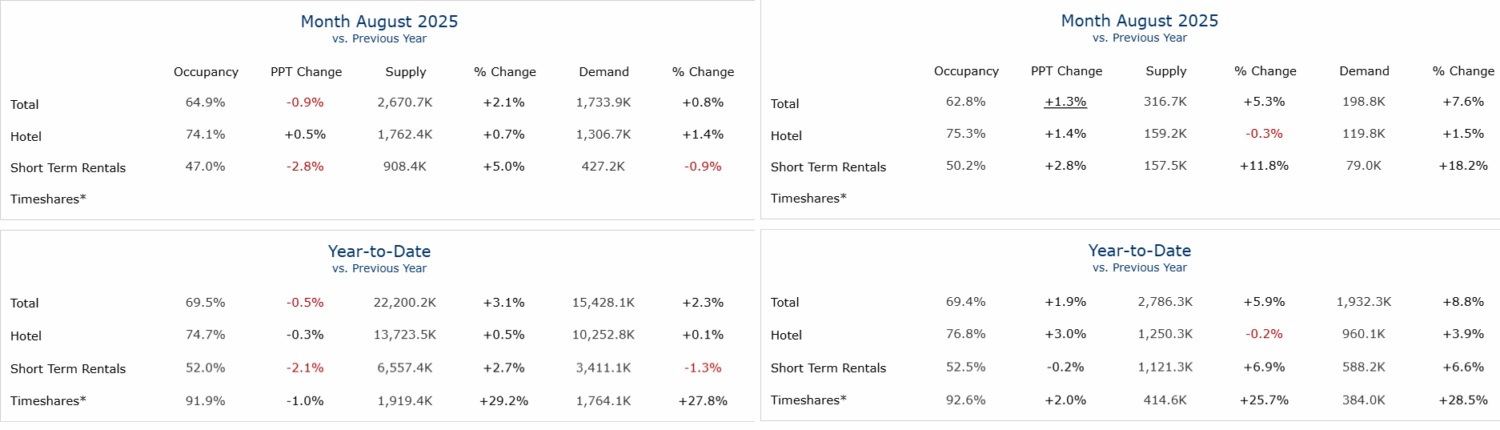
State of Hawai’i (LEFT) vs Kaua’i (RIGHT) monthly and year to date occupancy, supply, and demand statistics. Source: Hawai’i Tourism Authority (hawaiitourismauthority.org)
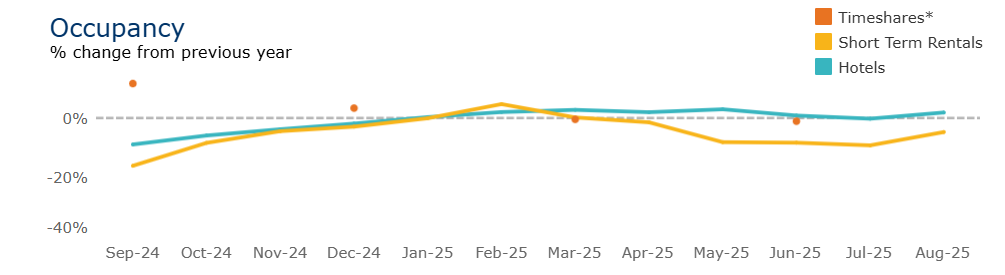
Sep 2024-Aug 2025 changes in occupancy rates between Short Term Rentals and Hotels
Source: Hawai’i Tourism Authority (hawaiitourismauthority.org)

And you don’t need to be an economist to figure that more supply than demand is bad for business. So, while the future of the market is never certain, the smart approach would be to treat these downward trends as the new normal, and try to price your units accordingly. If business is slow, keeping rates down to remain competitive is a much stronger strategy than hoping for a sudden uptick in visitor activity. Middle-income vacation rental properties are the most competitive rental market, therefore they need to be the most responsive to guest spending habits. Luxury rentals and extreme budget rentals both cater to specific audiences, and are therefore able to take a much less reactive approach. And while it can be daunting to suddenly have to drop prices, or suddenly increase them in a strong season, it also gives us the advantage of being able to realistically meet guests at their spending level, while still providing a great vacation rental experience. 


I’m A Guest! How Can I Use this Opportunity to Find Affordable Accommodations?


Although shoulder seasons are famously slow in seasonal destinations, they’re also famously full of good deals. And as the middle-income rental market continues to have its struggles, those deals can be found year-round in many cases. One important thing to understand in the short-term rental market, is that the updatedness of the property varies largely. This is especially true of the units on Kaua’i, where the location is isolated, new construction is slow to be completed, buildings are old, and supplies take weeks, or even months, to ship from the mainland. If you want to stay in a completely remodeled condo with air-conditioning, you’re going to be seeing prices that are consistently higher, sometimes even higher than the luxury hotels on the island. If you don’t mind, however, staying in a condo with a kitchen from the ‘70s, or an out of date bathroom, then you’ll be able to find great deals on rentals, especially if you’re looking last minute. Oftentimes the older units are half the price of the remodeled ones, and on an island where visitation costs are already high, saving $300 makes a world of difference.  


Looking Forward to the Future


As we said before, it’s impossible to know if this ongoing downward trend in visitor activity is the new normal, or just a momentary trend, but either way we want our owners and our guests both to have an optimal experience. We’ll continue to provide the same great vacation rental experience for all our guests, while honestly and professionally guiding our owners through the ups and downs of a market that changes every quarter, every year. 
Summer season is in full swing on the islands, and while summer typically sees occupancy rates that rival the winter high season, recent visitor statistics reflect a definite and unusual decline in arrivals to Hawai’i, a trend that is mirrored on Kauai. We’ve been monitoring this so-called “summer slump” and what it means, and while the numbers can be concerning, read on to see why we’re still optimistic about the state of vacationing on Kauai

The Slump in Vacation Rentals

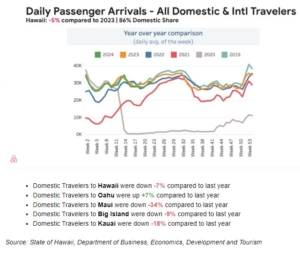
Although numbers continue to recover from the pandemic-era downturn, Kauai’s vacation rental market is experiencing a noticeable slowdown, with fewer bookings and declining occupancy rates. April 2024 visitor arrival rates dropped an enormous 11.5% compared to April of 2023, and 2024 year to date visitor arrivals to Kauai have dropped by 3%, statewide by 5%.. This trend has left property owners and managers across the islands grappling with reduced revenue and increased competition for bookings.

Graph of passenger arrivals to the islands, year over year comparison

State-wide we are seeing a decrease in visitor arrivals, coupled with a shift away from short-term vacation rentals. While anti-short term rental sentiment is not new, this has been a particularly incendiary topic this year with the passing of Hawai’i Senate Bill 2919, which you can read about in our previous blog post, as well as the election of a new pro-hotel president to the Hawai’i Tourism Authority.

As average vacation rental occupancy statewide has slumped to barely more than 50%, hotel occupancy remains strong at close to 75%.  A search performed today (June 11, 2024) on Airbnb showed nearly 600 properties on Kauai with the entire month of July vacant; in other words not a single night booked. In fact, nearly 500 properties have no nights booked between June 11 and August 1.

Screenshot of an Airbnb search for units vacant in the month of July, with 680 results

This is not to say that those properties are all going to remain empty, as booking patterns have shifted so that lead times are shorter and last-minute reservations are more common. It’s another market shift we’re learning to navigate. One way we’re doing that here is by taking advantage of a new integration offered by an OTA (online travel agent) specifically marketing to last minute travelers. Units are offered at a discounted rate, naturally, but this integration provides a dedicated outlet for filling those unbooked nights.

Top industry presences such as Vacasa, Hawaii’s largest vacation rental company, have begun to feel the impacts of this prolonged slump as they recently announced layoffs of 13% of their staff, and a vacation rental inventory decrease of 25% in the last year. While these numbers certainly seem foreboding, we continue to feel optimistic about the state of the economy on Kauai.

Economic Resilience and Consistency on Kauai

Although Kauai is typically thought of as a microcosmic reflection of broader state trends, the Kauai economy functions slightly differently. As a more lush and remote location, Kauai maintains destination desirability that more populous islands don’t necessarily have. For instance, despite the decrease in both April and year to date visitor arrivals, visitor spending per person per day was up 18%, and per person per trip spending was up 18% as well. If this trend continues, Kauai should maintain the consistent economic growth we’ve seen in the years preceding the pandemic. As an economy, however, Kauai is highly dependent on the mainland United States visitor pool… This means that as the U.S. heads towards a possible recession later this year, the Kauai economy could take a hit as mainland tourists struggle to afford vacations.

Navigating the Challenges Ahead

Despite the current challenges facing the vacation rental market in Kauai, there are opportunities for property owners and managers to adapt and thrive. With an increasing number of vacancies in short term rentals across the island, fueled not only by the drop in visitor arrivals, but also by a dramatic increase in the number of available rentals, and a preference shift towards hotel/resort experiences, visitors are going to be more particular about where they stay, and will be on the hunt for a good bargain. Aging units that are not kept up to date have been, and will continue to be, hit the hardest by this slump, regardless of “bargain pricing”. By adapting to new customer expectations and keeping our units up to date, we feel confident that we will continue to rent more robustly than our competitors, retain repeat visitors, and continue to have customers leave feeling satisfied with their vacation.

More Information

For a comprehensive overview of the numbers, we recommend the following websites and reports:

  1. Hawai’i Department of Business, Economic Development, and Tourism’s report on visitor arrivals and spending in April 2024: https://dbedt.hawaii.gov/blog/24-29/
  2. The Economic Research Organization at the University of Hawai’i’s Kauai Economic Outlook Summary: https://kauaiforward.com/wp-content/uploads/2024/06/23q2_kauaiforecast_1.pdf