
Shelling and Beachcombing on Kaua’i
Shelling and Beachcombing on Kaua’i: Common Finds, Best Practices, and Beach Recs
Beautiful seashells of all shapes and colors are some of the most ubiquitous symbols of a beautiful beach vacation. Shells are easily portable, uniquely beautiful, and free; they make the perfect souvenir! Although it may be tempting to hit the beach everyday and come home with a huge haul of seashells to display and remember your vacation fondly, it’s important that shelling and beachcombing are done with respect, both to the land and its people, and to the law. In this guide we’ll be going through everything you need to know before sifting through the sand!
What Can I Collect?: State Regulations and Local Customs
Shelling and beachcombing can be a hotly debated subject, especially on Hawai’i. Generally, though, if you practice respect and moderation, you should be fine. These are the most important guidelines to keep in mind as you comb the beach, and look for your prizes to take home:
- Never pick up a live shell. Seashells are a crucial part of the aquatic ecosystem, as they provide neat little homes for a number of small sea creatures. If you see a shell moving, or something peeking out from inside, leave it where it is. This is especially important when shells are underwater, as they are more likely to be occupied.
- Do not take any rocks, sand, plants, or coral. Per Hawai‘i Revised Statute (HRS) §171-58.5 and §205A-44, taking any coral, coral rubble, rocks, or sand from any beaches in the state is illegal. Littoral zones (beaches) are delicate ecosystems, and all of these items are crucial for maintaining balance. While taking plants home is not specifically prohibited, this too can disrupt the ecosystem, and will also provide a bit of a headache going through agricultural customs at the airport.
- Less is more. When shelling, err on the side of moderation. Not only will it leave exciting treasures for others to discover, but it will help preserve the environment. Additionally, collecting large numbers of shells for commercial purposes is strictly prohibited without a license. If you’re looking for enough shells to supply your next creative project, you’re better off visiting a local vendor and purchasing from them.
- Leave the area better than when you found it. When taking something beautiful from the beach, it’s best practice to collect any trash you come across in the process and dispose of it properly. Many shellers and beachcombers like to keep bags with them to collect trash as they search, both as a way of giving thanks, and to practice environmental responsibility. In Hawaiian culture, it’s important to offer something to the ocean in return as a thank you, and picking up any trash you see along the way is the perfect mahalo!
What You May See: Common Shells and Coveted Finds on Kaua’i
Although Kaua’i generally has fewer seashells than the other islands due to the coral reefs ringing much of the island, you should still have some luck. Here are some common shells you’ll be more likely to come across, as well as some highly sought-after shells you may be lucky enough to see!
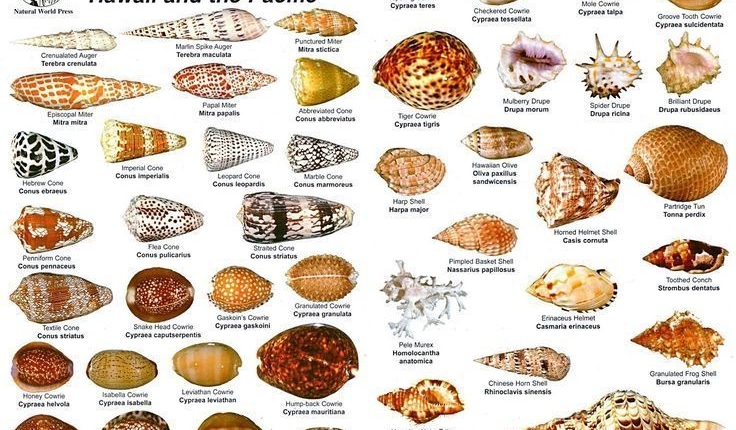
A graphic showing many common Hawaiian shells, including cones, augers, and drupes.
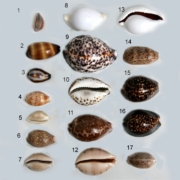
Common cowrie shell varieties.
- Cowrie Shells: Cowrie shells are some of the most common on the Hawaiian islands, and can be easily identified by their distinct shape. Although they come in a variety of different colors and sizes, cowrie shells all have the distinctive folded oval shape, with a ridged seam on the underside of the shell.
- Drupe Shells: Drupe shells are also fairly common on the beaches of Kaua’i. These small shells look a lot like giant conch shells, just shrunken. They have a similar spiral shape, with distinctive spikes or ridges along the rounded edge of the shell. Like most shells, drupes come in a variety of colors and sizes, though white lipped and mulberry drupes are the most common varieties on the island.

In tact sea urchin exoskeletons
- Sea Urchin Exoskeletons: These small, globe-shaped shells are fairly common on Kaua’i, but extremely difficult to find intact. Because they’re so delicate, you’re more likely to come across fragments of shell, so finding a complete exoskeleton is a real treat!
- Cone and Abridged Cone Shells: Like most other shells, cones come in all sizes and colors. Some of the most common ones include Hebrew cones, leopard cones, flea cones, and the smaller, chunkier abridged cones. It’s very important to check that any cone shells you see are empty, as many small, venomous snails like to claim these shells as their homes. While their stings are not typically fatal to humans, they can still cause pain, swelling, and discomfort, and require medical treatment.
- Auger Shells: Auger shells are the smaller, pointier cousins of cone shells. Auger shells are typically found in a variety of cream colors, and have a small opening on one end that tapers down to a sharp point. These shells will also occasionally house venomous snails, and should be thoroughly checked before handling.
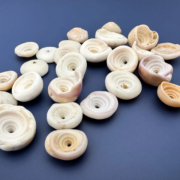
A variety of small puka shells. Note that they don’t sit flat due to the domed shape.
- Puka Shells: Puka shells, though often imitated, are actually fairly difficult to find on Kaua’i’s beaches. These small shells are actually the broken off and ground down apexes of cone shells, and puka refers to the small hole in the middle that makes these perfect for stringing into necklaces or bracelets. Naturally occurring puka shells will have a slight dome on one side of the shell, and the puka in the middle will be slightly irregular in shape.
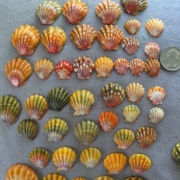
Tiny, scalloped sunrise shells in an array of colors.
- Sunrise Shells: Sunrise shells were previously used to make jewelry for Hawaiian royalty, and have since become a coveted find for any beachcomber’s collection. These small shells have a classic scallop shape, and come in vibrant hues of pink, orange, yellow-gold, and green.
- Kahelelani/Ni’ihau Shells: Legally, the term “Ni’ihau Shells” only refers to shells actually gathered on the shores of Ni’ihau. Colloquially, though, this term is used to refer to three different types of tiny seashells, including Kahelelani shells. All three shell varieties under this umbrella, Kahelelani, momi, and lāiki, are roughly the size of your pinkie fingernail, and spiral shaped. Kahelelani shells in particular are known to be vibrant shades of red and pink.
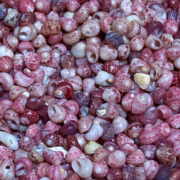
Kahelelani shells in an array of vibrant reds and pinks.
Where and When Should I Go Shelling?
The best part of shelling and beachcombing is that it can be done at any beach! Good shelling spots are closely guarded secrets, and the best way to discover a good shelling spot is to go out and look for yourself. Typically, though, you’ll want to go shelling around low tide, especially an hour before and after. You’ll need to be patient and work slowly for the best results, and you shouldn’t be afraid to look underwater either! Tide pools with just a few inches of water in them are the perfect spot to pick up some beautiful shells. Floating face down in very shallow water near the shore and slowly combing through the sand with your hands is another popular technique. While we truly do recommend shelling at whichever beach you find yourself on, Tunnels and Anini beaches on the North Shore are popular choices with beachcombers, as well as Shipwreck Beach on the South Shore. Happy shelling!